When I started working with external creative partners, I had a big creative team in China. The output was good. The problem was that our main markets were the US and EU, and at some point leadership started asking a fair question: can a team that doesn't live in those markets really build creatives that land culturally in them?
So the plan was to bring in new creative partners that could produce fresh concepts to complement our creative team's pipeline, developed independently.
That is a harder balance than it sounds. To get ideas that aren't shaped by what your internal team is already doing, you have to give the creative partner real independence. But give too much freedom with no direction, and you get something else entirely.
What minimal guidance actually produces
My first instinct was that if I wanted genuinely new concepts, I should stay out of the ideation process and give the creative partner as little input as possible. Let them think freely.
It didn't work. Every time, we ended up with replicas of competitor creatives, or slight adaptations of ideas we had already tested ourselves. The creative partner had no way of knowing what we'd burned through, so they reached for the same obvious references everyone reaches for. Instead of speeding up our learning, it stretched it out.
The problem wasn't the freedom. It was that the freedom had no starting point.
Giving creative partners a map instead of a leash
So I built one. I categorized the creatives we develop internally into four types, which gave me a clean way to tell a creative partner what to avoid and where we actually wanted them to play.
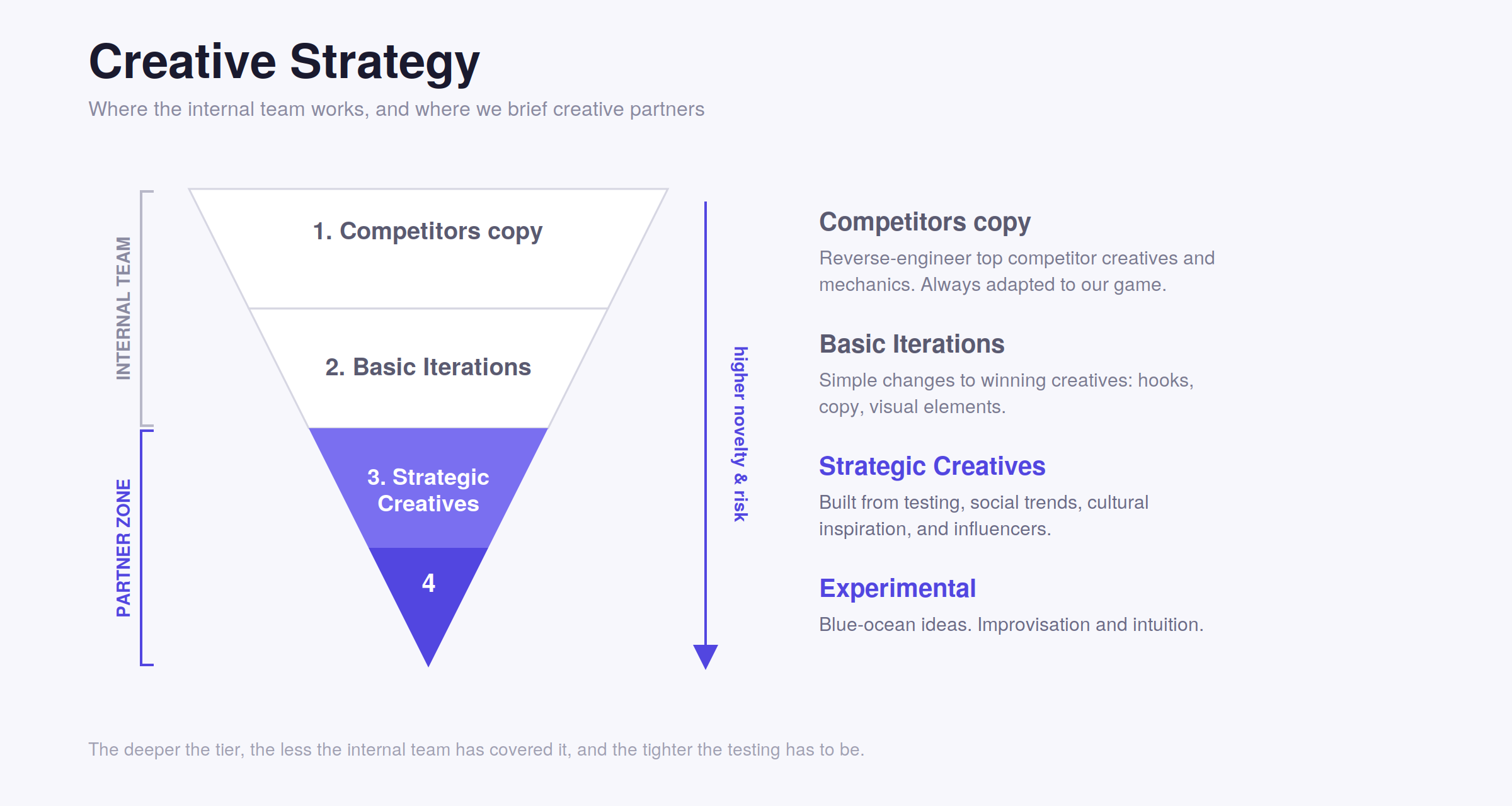
The top of the framework is where most creative production lives. Competitor copies and basic iterations on winning ads are useful, but our internal team already owns that work. There was no point paying a creative partner to duplicate it.
What I wanted from creative partners was the bottom of the framework: strategic and experimental creatives. The concepts that come out of testing, social trends, cultural inspiration, and improvisation. That last part connected straight back to the original worry about our China team. Cultural relevance was exactly the gap I was hoping an outside creative partner could fill.
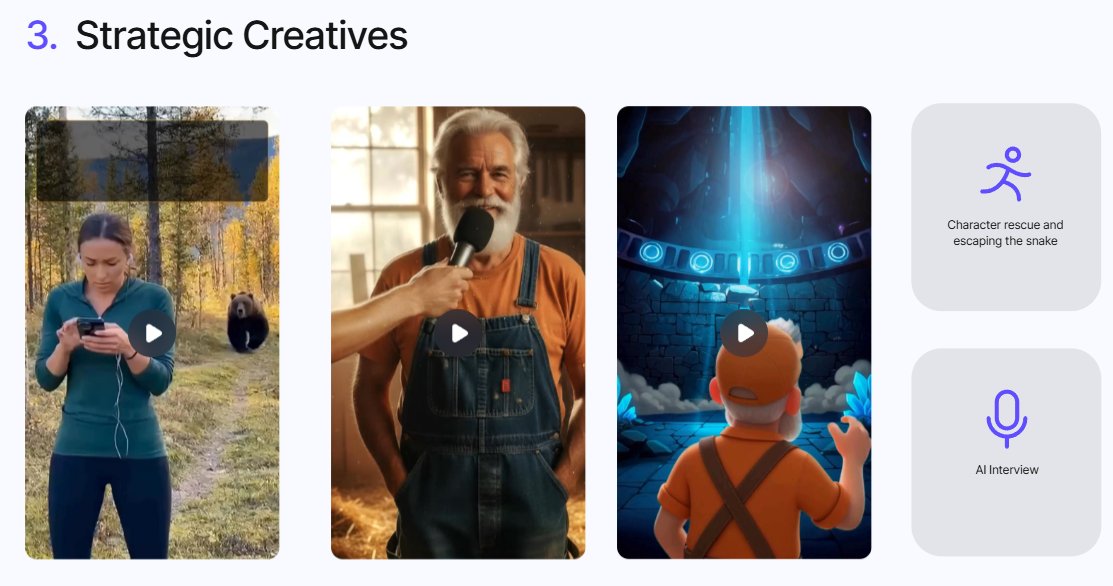
These are the kind of strategic concepts we were after, ideas built from social trends and cultural angles rather than another pass at a competitor's ad.
The catch is that those bottom two tiers are also the riskiest. When we asked creative partners to explore high-risk concepts for a title like Wood Block, ideas we had never produced or tested before, those creatives could swing overall performance in either direction. So the freedom had to come with a tighter testing framework around it. Independence on the idea, discipline on the testing.
The creative partner that landed on the first brief
Once the starting point was clear, one creative partner stood out. I tested roughly 30 of them the same way, and AdSpawn was one of the very few whose first creatives landed on brief.
They were aligned with how we wanted to work before we even started. They prefer to develop ideas independently from the client's internal team, which is exactly the independence I was after.
The one thing I hesitated on was their minimum three-month commitment. My instinct is always to run a single small batch as a test before committing to anything longer. But I realized that if I trusted my own guardrails, the commitment wasn't really a risk. Good guardrails are what make a longer commitment safe, because you already know the creative partner is pointed in the right direction.
Right on the first batch I noticed the output was different. The concepts were far from competitor replicas, genuinely interesting ideas that combined small characteristics of different concepts. They were the first creative partner to independently deliver 60-second videos without us having to request them, which was very relevant for us since we were scaling on Unity and AppLovin.
That told me they understood the channel, not just the format. And the CPI on the first delivery was good, not after three rounds of revisions.
The work
What I'd tell anyone working with creative partners
Original creative and useful direction are not opposites. The mistake I made early was treating them as a trade-off, as if any input I gave would contaminate the creative partner's thinking. The opposite turned out to be true. A clear starting point is what let creative partners be genuinely original, because it freed them from guessing at what we had already done.
Build the guardrails first. Tell creative partners what to avoid and where to push. Then find a partner that knows what to do with the room you've given them.
AdSpawn was one of the few that did.