When we started working with agencies, we knew we wanted to build a framework for testing new ideas that would complement the creatives produced by our internal team.
In casual gaming, misleading ads grab attention in a way pure gameplay videos rarely can, which makes them hard to ignore when you are trying to scale. The problem is the trade-off: the more a misleading concept drifts from the real game, the more you risk hurting retention once players install. We wanted the attention without paying that price.
We decided to scale the production of misleading ad concepts. The issue was cost. Misleading ads require complete production from scratch. We couldn't use game recordings, so every creative cost more and the whole process got slower.
Fake intros
At the time we were partnering with Louis from Quadral, our first agency partner. We needed someone fast, full of new ideas, and able to deliver quality at reasonable prices.
The solution Louis came up with was to produce only fake intros: 5 to 10 seconds of fake gameplay that then transition into actual gameplay.
This was the responsible middle ground we were looking for. The fake intro gives the creative the attention-grabbing hook of a misleading ad, but because the player still sees the real game experience before the ad ends, the risk of hurting retention drops sharply. You get the upside of a misleading concept without fully abandoning real gameplay.
And that changed how we tested misleading concepts.
We worked together on dozens of new concepts, all ideas coming from Louis himself. He is genuinely creative. We never had to push for new angles, they just kept coming.
How we tested
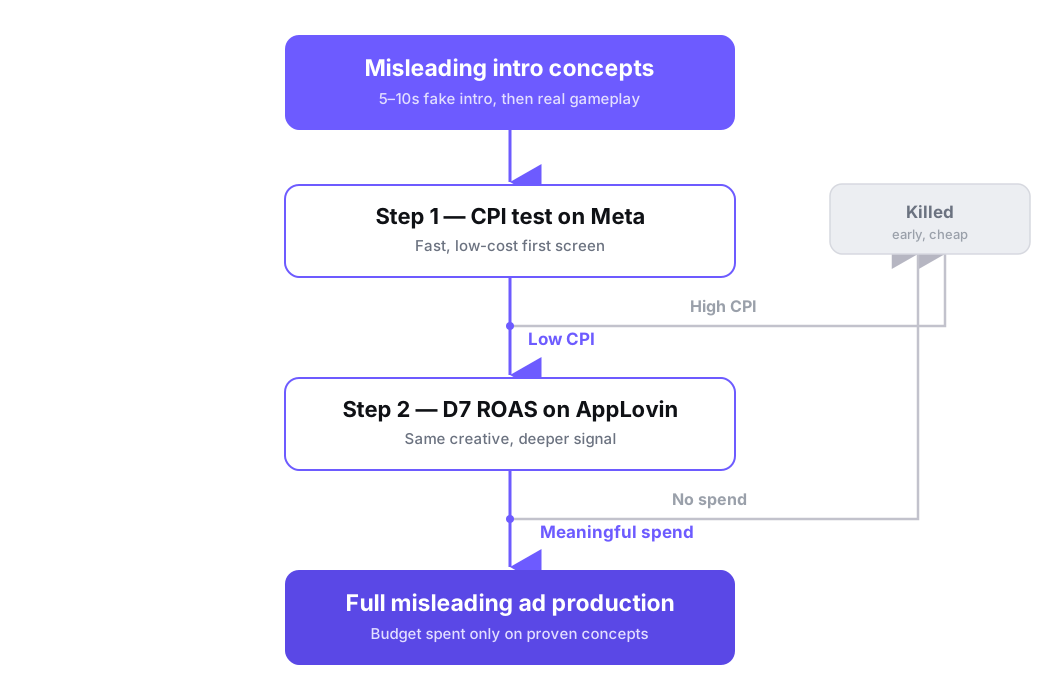
We ran these creatives on both Meta and AppLovin, with a different role for each channel. On Meta we used the classic CPI test. We like it because it is fast and inexpensive, which is exactly what you want when the whole point is a quick, low-cost way to screen a batch of intros.
The flow was simple. First, a CPI test on Meta. Then we would add the same creative to a D7 ROAS campaign on AppLovin. If the creative landed a low CPI on Meta and went on to generate meaningful spend in the AppLovin campaign, that was our signal to commit to full misleading ad production.
What we learned
One of the first findings was that any misleading ad without a similar game mechanic was extremely hard to turn into a success. The hit rate was naturally lower, and we had to accept that finding a winner with 100% misleading concepts would mean testing a far bigger number of creatives, which in turn means a much higher creative production investment.
So instead of developing 100% misleading concepts, we focused on ideas that could still relate to the game in some way: a new level, a tweak to the main mechanic, something that gave the creative a new edge and made it stand out from everything else in the feed.
This had a useful side effect. Because these concepts stayed close to the game, the strong ones doubled as fresh hooks for our existing top creatives. We were effectively refreshing our best performers and testing misleading concepts at the same time, at a fraction of the usual cost.
Conclusion
The fake intro approach changed the economics of testing for us. Concepts that used to need full production before we could read them were now answered by a 5 to 10 second intro, which meant we could test far more ideas, kill the weak ones early, and spend real production money only on the concepts that had already earned it. All of that without putting retention at risk, because the real game was always there in the creative.
None of this happens without the right partner. You need an agency that can turn around new ideas quickly, stay close to the game instead of chasing misleading hooks, and deliver at a price that makes high-volume testing realistic. Louis was that partner for us, and he is a big part of why this became the way we work rather than a one-off experiment.