When we first started working with agencies, our creative team was deeply involved in approving the concepts. Every idea an agency sent over went through them before it got anywhere near a live campaign. In principle that felt like the responsible thing to do. In practice it became the slowest part of the whole process.
But the speed wasn't even the real problem.
The real problem was that the gatekeeping quietly worked against the thing we were trying to build.
The Udonis example
We saw this play out clearly with Udonis.
In one of the first batches they shared with me, there was a concept that felt unlikely to land. On paper there was nothing about it that made the team believe it could perform.
We had to narrow the batch down to a few concepts for production, and this one was about to get cut.
But the entire reason for bringing in agencies was to get ideas our own team wouldn't have come up with. Fresh angles from people who weren't sitting in our creative meetings every week. And yet here we were, handing those ideas straight back to that same internal team and asking them to decide which ones were worth running.
When you step back, it doesn't hold together. You go looking for an outside perspective, then filter it through inside taste. The concepts that survive that filter are, almost by definition, the ones that look most like what your team already believes in. Which is the opposite of what you set out to buy.
At the last minute we decided to keep it in.
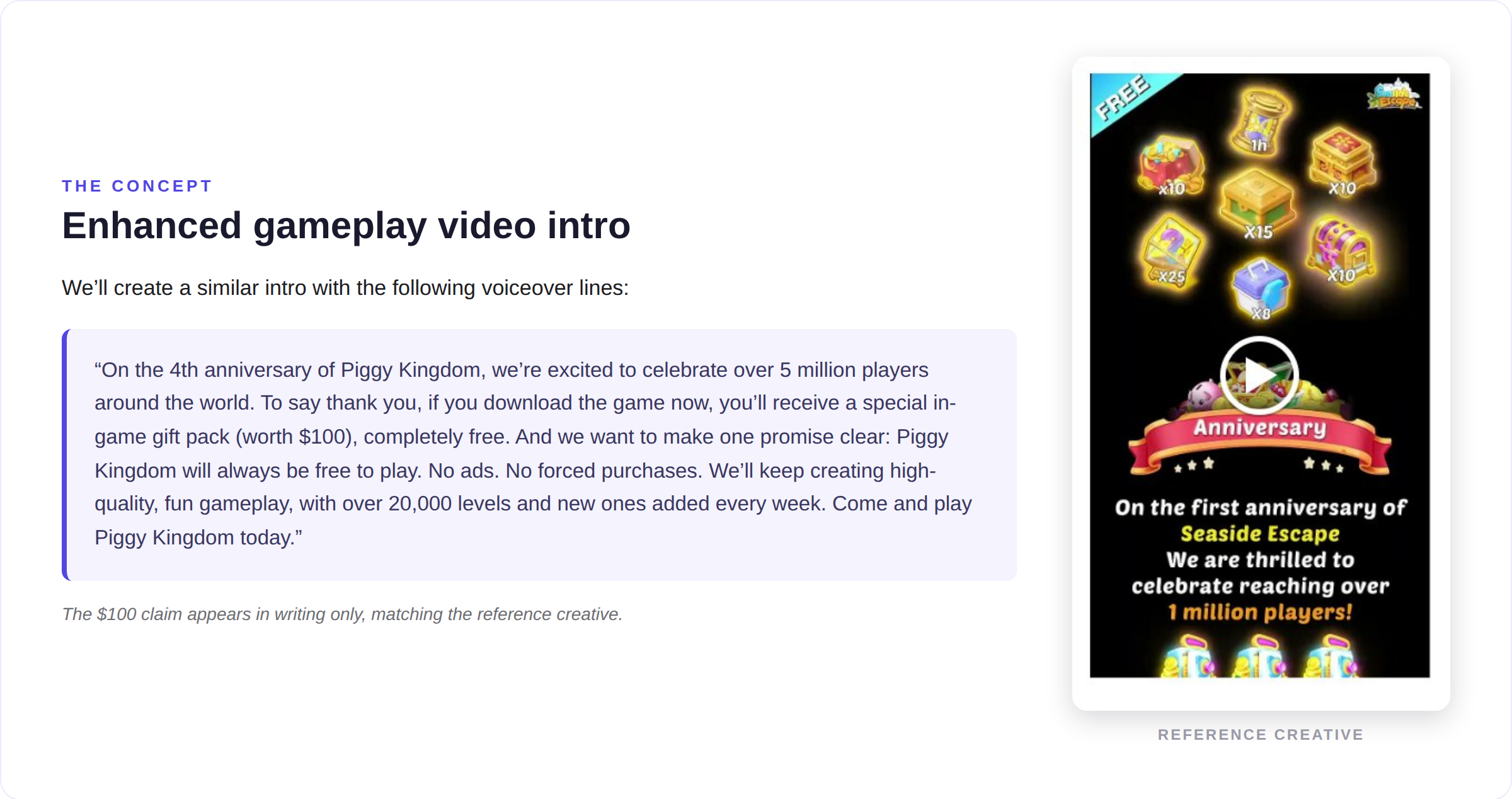
Once it went into our testing campaigns it started spending fast. On AppLovin it scaled almost immediately, and within a few days it was already doing tens of thousands a day. The team began building variations off it, and within two months the concept was generating over a million dollars in spend.
That doesn't mean our team was bad at spotting good ideas. It means their instinct, like anyone's, is built on what has worked before, and a genuinely new concept has no track record to recognize. The only thing that can judge it fairly is a test.
That's also exactly what made Udonis worth working with. The ideas they brought didn't pattern-match to what we already had in the pipeline, and the one that paid off was one we never would have produced ourselves. But trusting a partner instead of your own team only works if the testing backs it up, and Udonis proved it can.
What we changed
After that, we stopped giving the internal team a veto over agency concepts and built a testing framework around the results instead.
Our own team's creative testing set the benchmark. Every agency we worked with was scored against that benchmark in the first round of testing, rated on how likely each creative was to scale. An A meant a strong chance of scaling, a B meant a reasonable chance, and anything above that missed the benchmark and was unlikely to go anywhere.
| Agency | Creatives | Rate A | Rate B | Missed benchmark |
|---|---|---|---|---|
| Internal team | 96 | 15% | 52% | 32% |
| Agency 1 | 29 | 12% | 51% | 37% |
| Agency 2 | 28 | 16% | 74% | 10% |
| Udonis | 14 | 18% | 59% | 24% |
| Agency 3 | 14 | 11% | 50% | 39% |
| Agency 4 | 6 | 0% | 50% | 50% |
| Agency 5 | 5 | 0% | 60% | 40% |
By this point we already had a solid framework for these partnerships, and it was working. A few agencies were clearing our internal benchmark, but Udonis stood out where it counts most. Nearly one in five of their creatives earned an A, our top rating and the strongest signal a concept can scale. That was the highest share of anyone we tested, our own team included. And it held across fourteen creatives, not a single lucky hit. A high rate of scalable ideas plus the consistency to repeat it is a rare pairing.
The work
The concept Udonis produced, alongside two variations our internal team built off it once it started scaling.
The takeaway
If you're building a way to work with agencies, be careful about who gets to say no. The instinct to have your best people sign off on everything feels reasonable, but it can quietly undo the whole reason you went outside in the first place.
That isn't an argument for removing all direction. You still set the guardrails and the kind of thing you're looking for. What changes is the job itself. Instead of approving ideas, your team defines the conditions a good idea has to clear, and the decision goes to the test.
It's faster, and it's more honest. You stop pretending you can tell which idea will work just by looking at it. The concept our own team almost passed on is proof enough for me.
But that only works if the results are there. Take the veto away and testing becomes the thing that earns a partner your trust, round after round. Udonis is the one that earned it.